
History of Maratha Empire
Introduction: Who Were the Marathas?
The Maratha empire has a rich history of bravery, perseverance, and struggle for freedom from the Mughal Empire.Background Marathas was a tribal community, with a focus on a dominant warrior class, primarily from the western region of India, with Maharashtra as its base. The 17th-18th century where they unfolded as the apex political power that challenged the Mughal Empire, also were a power against the British. The Marathas were more than a political/military potency within Indian communities; they were a vision of self-determination, positioned against the cultural arrogance of Mughals and Britishers, and left a profound legacy that impacted the socio-political trajectory of India. history of maratha empire
Foundations of the Maratha Empire
Shivaji Maharaj: The Great Founder
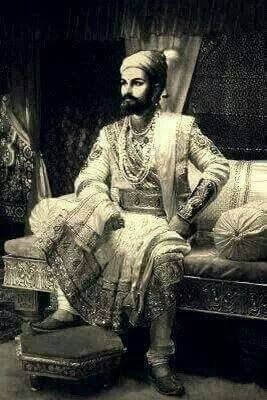
Chhatrapati Shivaji Maharaj, a visionary leader founded the Maratha Empire in 1630. He was a leader with an exceptionally strong sense of justice, religious tolerance, and administration. His fearless and strategic mentality established a powerful Hindu kingdom in an era of larger empires.
Socio-political Conditions in 17th-century India
The 17th century in India was marked by the decline of Mughal authority and increased turmoil from local chieftains. The heavy tax systems and foreign rule lay the foundation for new regional authorities like the Marathas to emerge. Shivaji took advantage of this environment, and created a kingdom based on local governance and cultural identity. history of maratha empire
The Role of Geography and Forts in Maratha Strategy
The rocky landscape of the Western Ghats shaped the military strategy of the Marathas in the shape of a car tire. The Marathas built and maintained many hill forts. Hill forts that became pivotal to the Maratha resilience were forts such as Raigad, Sinhagad, and Pratapgad. Hill forts provided a secure base for the Marathas to resist larger, imperial forces using surprise attacks and guerrilla tactics on their mounts.
Rise of Chhatrapati Shivaji Maharaj
Early Life and Leadership
Shivaji learned about politics, war and ethics from his mother Jijabai and mentor Dadoji Konddeo. Even at the age of twelve, Shivaji displayed a knack for leadership and brought together local youth to fight against injustice and foreign rule. history of maratha empire
Military Tactics and Administration
Shivaji’s one of the greatest assets was his reliance on guerrilla warfare or “Ganimi Kava.” His army was mobile, efficient and loyal. In addition to warfare, Shivaji also provided a well-rounded administrative regime, which encouraged merit-based appointments, fair taxes and protection of peasants.
Coronation and Creation of Hindavi Swarajya
Shivaji was ceremonially anointed as Chhatrapati at Raigad Fort, in 1674, and Hindavi Swarajya—self-rule by the Hindus—was formally declared. This coronation went far beyond ceremony, it was a proactive declaration of independence from foreign powers.

Expansion After Shivaji
Rule of Sambhaji and Others
After the demise of Shivaji, his intermitty son Sambhaji became king in the midst of political unrest and external peril. Edging the Mughal Empire he was eventually caught and killed by the Mughals, yet he grew a legendary status for his bravery. The successors of Sambhaji, Rajaram and Tarabai persevered and carved out a coast to reside and continue the resistance. history of maratha empire
The Role of Peshwas in Maratha Growth
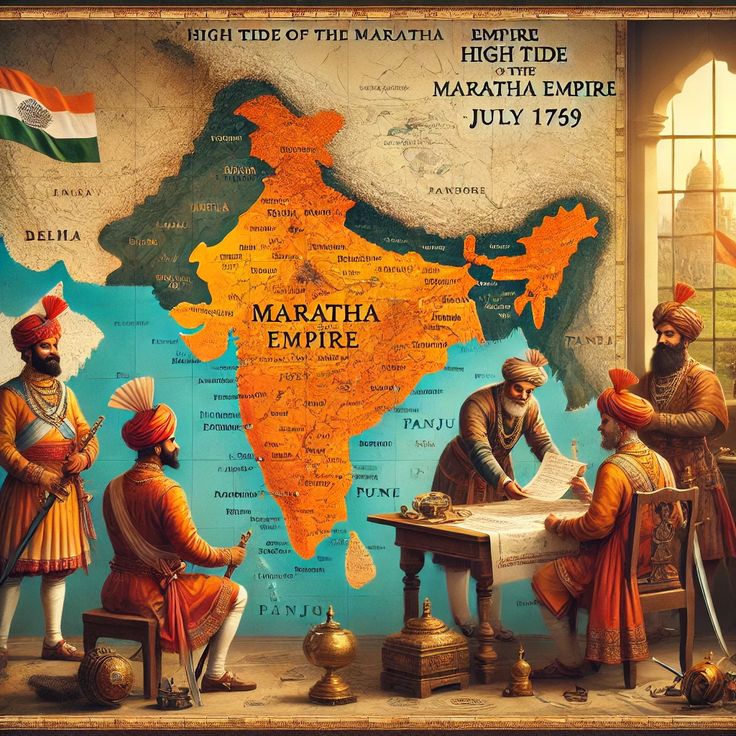
The actual expanse of the Maratha Empire occured under the leadership of the Peshwas, the Prime Minister role that became the de facto ruler of the empire. The Peshwa who achieved this was Peshwa Baji Rao I. Peshwa Baji Rao I was extremely effective and elevated Maratha influence across the entire Indian subcontinent ranging from the Deccan to northern India, and established the Marathas as the most powerful Indian force in the 18th century.
Major Battles and Conquests Across India
The Marathas contested important battles all over India, they won battles in Malwa, Gujarat, and Odisha. They mounted military expeditions to as far as Attock (now in Pakistan). While such military presence demonstrated their dominance, they also sowed the seeds of their own vulnerability!! history of maratha empire
Conflicts with the Mughals and British
Maratha-Mughal Wars
The Marathas were one of the first Indian powers to actively resist the Mughals, and their incessant fights and battles for territory chipped away at Mughal power in central India and created an alternative center of power in the subcontinent.
Battles Like Panipat and Their Consequences
The Third Battle of Panipat changed the tide. The Marathas faced a brutal defeat by Ahmad Shah Abdali’s forces in 1761, yet they were able to recover and re-establish themselves within a decade; a testament to their deep-seated strength.
Relations with the British East India Company
Initially, the Marathas had a careful relationship with the British. Nevertheless, as British power grew, clashes followed, with escalating conflicts leading to the Anglo-Maratha Wars, which would weaken the Maratha Empire and let British Colonialism prosper. history of maratha empire
The Maratha Confederacy
Structure and Functioning of the Confederacyany
Throughout the late 18th century it could be seen that the Maratha Empire was functioning more like a confederacy of semi-autonomous states instead of being a centralized power. Winners and losers formed individual regions to be controlled by prominent families under weak central control.
Key Families: Scindias, Holkars, Gaekwads, and Bhonsles
Great Maratha families such as the Scindias of Gwalior, Holkars of Indore, Gaekwads of Baroda, and Bhonsles of Nagpur had control over large regions of the empire. As powerful as they were, their competition with one another for power often diminished the power of the empire, which ultimately made it vulnerable to the British who were able to take advantage of their disputes.
Decline of the Maratha Empire
Internal Divisions and Loss of Central Control
The greatest threat to the Maratha Empire was an internal one. There were substantial power struggles, a lack of unity, and regional rivalries disintegrated the Empire. What was once a unified military front began to fracture. history of maratha empire
Defeat in the Third Anglo-Maratha War (1818)
The Third Anglo-Maratha War in 1818 was the final nail in the coffin. The British East India Company was victorious, and the Maratha Empire was formally ended. This meant British rule was secured in India for the next century.
Legacy of the Marathas
Contributions to Military, Governance, and Culture
The Marathas were early innovators of decentralized governance, military bureaucracies, and patronage of culture. Their strongholds, written works, and impact heritage remain familiar today in the form of public pride and powerful observances in Maharashtra and across state lines.
Influence on Modern Maharashtra and Indian Nationalism
Shivaji earlier sowed the ideals of Swarajya (self-rule) and National Pride, values which inspirited freedom fighters in the later 19th century and into the 20th century. Today, the Maratha empire represents a history that serves as a source of identity, particularly in the state of Maharashtra which embodies several values including valor, self-respect, and resistance. history of maratha empire
Conclusion: Lessons from Maratha History
The Maratha history is a lesson that nations can be built through unity, vision and pride in culture. They fell because of internal rift but they will be remembered for their bravery, perseverance, and administrative skills. India in the present can take their example of self-rule, sense of justice and governance based on locality. history of maratha empire
Customer FAQs
Q1. Who founded the Maratha Empire?
A: Chhatrapati Shivaji Maharaj is credited with founding the Maratha Empire in the 17th century.
Q2. What was Hindavi Swarajya?
A: Hindavi Swarajya means self-rule by Indians, especially Hindus, as envisioned by Shivaji.
Q3. What led to the decline of the Maratha Empire?
A: Internal divisions, overexpansion, and British intervention ultimately led to their decline.
Q4. Who were the key leaders after Shivaji?
A: Notable leaders include Sambhaji, Peshwa Baji Rao I, Mahadji Scindia, and others.
Q5. Why is the Maratha Empire important today?
A: It symbolizes Indian resistance, administrative brilliance, and cultural pride, especially in Maharashtra.
Pingback: Indus Valley Civilization - nearlibrary.com
Pingback: History of Hindu Religion